Professional Packaging Standards for International Mobile Phone Shipping
Part 1 — Introduction, Regulatory Framework & Packaging Workflow
1. Introduction: Why Phone Packaging Standards Matter in Air Freight
Mobile phones are among the most frequently transported lithium battery-powered electronic devices in global air cargo operations. Unlike general consumer goods, smartphones contain lithium-ion batteries embedded within equipment, which places them under strict international dangerous goods regulations during air transport.
Even though most mobile phones are classified as UN3481 – Lithium ion batteries contained in equipment, the risk profile remains significant due to:
- Thermal runaway risk in damaged or defective batteries
- Short-circuit potential during handling or compression
- Sensitivity to impact, vibration, and pressure changes in air transport
- Strict airline acceptance policies for lithium battery cargo
For this reason, packaging is not only a protective measure but also a regulatory compliance requirement under international aviation safety frameworks.
A correctly designed phone packaging system ensures:
- Compliance with IATA and ICAO regulations
- Safe containment of lithium-ion batteries
- Reduced risk of cargo rejection
- Lower damage rates during transit
- Faster customs and airline acceptance
- Standardization across global logistics networks
This guideline provides a professional-level framework used in international air freight operations for mobile phones and similar lithium battery-powered consumer electronics.
2. International Regulatory Framework
Phone packaging for air freight is governed by a layered regulatory structure defined by international aviation authorities and technical institutions.
2.1 Primary Aviation Regulations
International Air Transport Association (IATA) Dangerous Goods Regulations (DGR)
The IATA DGR is the most widely adopted global standard for air transport of dangerous goods. It defines classification, packaging instructions, labeling requirements, and documentation procedures.
For mobile phones containing lithium-ion batteries, the applicable instruction is:
- Packing Instruction PI967
- Classification: UN3481 – Lithium ion batteries contained in equipment
International Civil Aviation Organization (ICAO) Technical Instructions
ICAO provides the legal foundation for dangerous goods transport by air under international law. IATA DGR is derived from ICAO Technical Instructions, ensuring global regulatory alignment.
ICAO defines:
- Safety thresholds for lithium batteries
- Packaging performance expectations
- Incident prevention requirements
- Operator and shipper responsibilities
2.2 United Nations Lithium Battery Testing Standard
UN Manual of Tests and Criteria – Section 38.3
All lithium batteries used in air transport must pass UN38.3 testing, which includes:
- Altitude simulation
- Thermal cycling
- Vibration test
- Shock test
- External short circuit
- Impact/crush test
- Overcharge and forced discharge
Only batteries that pass UN38.3 are legally eligible for air transport.
2.3 Supporting International Standards
| Standard | Role in Packaging System |
|---|---|
| ISO 780 | Packaging handling symbols |
| ISO 2234 | Stacking strength testing |
| ASTM D4169 | Distribution performance simulation |
| IEC 62133 | Battery safety standard |
| ISO 9001 | Quality management systems |
These standards ensure packaging is not only compliant but also mechanically robust under real-world logistics conditions.
3. Classification of Mobile Phones in Air Transport
In dangerous goods classification, mobile phones fall under:
UN3481 – Lithium ion batteries contained in equipment
This classification applies when:
- Battery is installed inside the device
- Battery is not shipped separately
- Equipment is powered by lithium-ion battery
Typical shipping scenarios include:
- Smartphones
- Tablets
- Handheld communication devices
- Wearable electronics (smart watches)
This classification determines:
- Packaging instruction (PI967)
- Labeling requirements
- Documentation obligations
- Airline acceptance conditions
4. Core Principles of Professional Phone Packaging
All compliant phone packaging systems are built on five engineering principles:
4.1 Mechanical Protection
Packaging must protect against:
- Vertical compression (stacking load)
- Horizontal vibration (aircraft turbulence)
- Impact during loading/unloading
- Drop shock in warehouse handling
4.2 Battery Safety Containment
Lithium-ion batteries must be protected from:
- Short circuit
- External pressure damage
- Thermal exposure
- Mechanical deformation
4.3 Movement Prevention
Internal movement is a primary cause of cargo damage. Packaging must eliminate:
- Product shifting inside cartons
- Contact between individual devices
- Friction between hard surfaces
4.4 Regulatory Compliance
Packaging must satisfy:
- IATA DGR requirements
- ICAO technical instructions
- Airline operator variations
- National customs regulations
4.5 Handling Efficiency
Packaging must be optimized for:
- Warehouse handling systems
- Pallet stacking compatibility
- Forklift transport
- Air cargo unit load devices (ULDs)
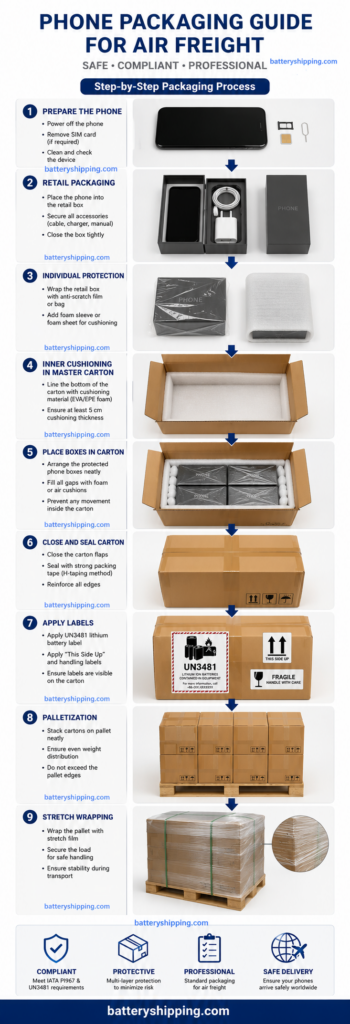
5. Professional Phone Packaging Workflow (Air Freight Standard)
The following workflow represents a standardized industrial process used in international air freight operations for mobile phones.
- Incoming Quality Inspection
↓ - Battery Compliance Verification (UN38.3)
↓ - Device Power-Off & Safety Check
↓ - Individual Retail Packaging
↓ - Internal Cushion Protection
↓ - Master Carton Assembly
↓ - Carton Sealing (H-Tape Method)
↓ - Dangerous Goods Marking & Labeling
↓ - Palletization (If Applicable)
↓ - Stretch Wrapping & Load Securing
↓ - Final Export Inspection
↓ - Airline Cargo Acceptance
6. Workflow Explanation (Engineering Perspective)
Step 1: Incoming Quality Inspection
Ensures all devices meet export readiness standards before entering logistics flow.
Step 2: Battery Compliance Verification
Confirms each lithium-ion battery meets UN38.3 certification requirements.
Step 3: Device Safety Preparation
Devices are powered off to eliminate accidental activation risk during transport.
Step 4: Retail Packaging
Ensures each device is independently protected and immobilized.
Step 5: Cushion Protection
Shock absorption materials prevent micro-impact damage during transport.
Step 6: Master Carton Assembly
Consolidates units into standardized export packaging units.
Step 7: Sealing
Ensures structural integrity during air cargo handling cycles.
Step 8: Labeling
Ensures regulatory identification and traceability.
Step 9: Palletization
Enables mechanical handling efficiency in airport logistics systems.
Step 10: Load Securing
Prevents cargo shift during turbulence and handling.
Step 11: Export Inspection
Final compliance verification before airline acceptance.
Step 12: Airline Acceptance
Cargo enters regulated air freight system under operator review.
Part 2 — Packaging Materials, Carton Engineering, Palletization & Labeling Standards
7. Packaging Materials for Mobile Phone Air Freight
The performance of a phone packaging system depends heavily on material selection. In air freight logistics, materials must balance shock absorption, compression resistance, weight efficiency, and regulatory compatibility.
7.1 Primary Cushioning Materials
EVA Foam (Ethylene Vinyl Acetate)
EVA foam is widely used in high-value electronics packaging due to its superior structural resilience.
Key properties:
- High shock absorption efficiency
- Excellent shape retention
- Resistant to deformation under pressure
- Suitable for precision-cut inserts
Use cases:
- Premium smartphone packaging
- OEM export packaging
- High-value electronics shipments
EPE Foam (Expandable Polyethylene)
EPE is a lightweight, cost-effective cushioning material commonly used in mass shipments.
Key properties:
- Lightweight structure
- Moderate shock absorption
- Cost-efficient
- Easy to cut and shape
Use cases:
- Bulk smartphone export shipments
- Retail carton cushioning
- Mid-range logistics operations
Honeycomb Paper Structure
Honeycomb paper is an environmentally friendly alternative increasingly used in international logistics.
Key properties:
- High compression resistance
- Eco-friendly material
- Excellent load dispersion
- Good for void filling
Use cases:
- Sustainable packaging systems
- Export cartons requiring void fill
- Medium protection requirements
Air Cushion (Inflatable Packaging)
Air cushions are commonly used for void filling in export cartons.
Key properties:
- Lightweight
- Flexible application
- Good vibration damping
- Efficient storage before inflation
Limitations:
- Lower compression resistance
- Not suitable as primary structural protection
7.2 Materials Not Recommended
| Material | Reason |
|---|---|
| Loose packing peanuts | Movement risk during vibration |
| Thin bubble wrap only | Insufficient compression resistance |
| Newspaper filler | Inconsistent density |
| Non-industrial foam | Poor structural reliability |
8. Export Carton Engineering Standards
Carton selection is a critical factor in preventing damage during air transport. Mobile phone shipments require industrial-grade corrugated packaging.
8.1 Corrugated Board Types
3-Layer Corrugated Board
- Not recommended for air freight
- Low compression strength
- Suitable only for lightweight domestic packaging
5-Layer Corrugated Board (Standard Export Grade)
This is the minimum recommended standard for mobile phone air freight.
Characteristics:
- High structural rigidity
- Good stacking strength
- Suitable for international transport
- Balanced cost-performance ratio
Double-Wall Corrugated Board
Used for high-volume or long-distance shipments.
Characteristics:
- Enhanced compression resistance
- Better stacking stability
- Suitable for palletized cargo
- Reduced deformation risk
Triple-Wall Corrugated Board
Used for industrial-grade or heavy electronics logistics.
Characteristics:
- Extremely high load-bearing capacity
- Suitable for extreme stacking conditions
- Higher cost and weight
8.2 Carton Strength Indicators
| Metric | Description | Recommended Value |
|---|---|---|
| ECT (Edge Crush Test) | Vertical compression resistance | ≥ 32 ECT (minimum) |
| Burst Strength | Resistance to rupture | ≥ 200–275 PSI |
| Compression Strength | Stack load resistance | Industrial standard required |
8.3 Carton Design Principles
Professional export cartons must follow these engineering principles:
- No empty internal movement space
- Balanced weight distribution
- Reinforced corner structure
- Uniform stacking geometry
- Moisture-resistant outer layer (recommended)
9. Palletization Standards for Phone Shipments
Palletization is essential for high-volume air freight shipments to ensure mechanical stability during airport handling and ULD loading.
9.1 Pallet Types
European Standard Pallet (EUR/EPAL)
- Size: 1200 × 800 mm
- Widely used in global logistics
- ISO standardized
North American Standard Pallet
- Size: 1200 × 1000 mm
- Common in transpacific trade routes
Plastic Pallets
- Lightweight
- No moisture absorption
- Reusable
- Higher cost
9.2 Pallet Loading Principles
Proper pallet loading must follow these rules:
- Cartons must align vertically
- No overhang beyond pallet edges
- Weight must be evenly distributed
- Heavy cartons placed at bottom layers
- Interlocking stacking recommended
9.3 Load Stability Requirements
To ensure safe air transport:
- Maximum tilt must be minimized
- No lateral shifting allowed
- Center of gravity must remain stable
- Forklift entry points must remain unobstructed
9.4 Load Securing Methods
| Method | Function |
|---|---|
| Stretch wrap | Structural stabilization |
| Plastic straps | Horizontal reinforcement |
| Corner boards | Edge protection |
| Top cover film | Dust and moisture protection |
10. Dangerous Goods Labeling & Marking Requirements
Proper labeling is mandatory for compliance with international air freight regulations.
10.1 Lithium Battery Mark (UN3481)
For mobile phones shipped with batteries installed, the required marking is:
UN3481 – Lithium ion batteries contained in equipment
This label must include:
- UN number
- Battery type indication
- Contact information (where required)
10.2 Handling Labels
Common required labels include:
- Lithium battery handling label
- Cargo aircraft only (if applicable)
- This side up arrows
- Fragile handling indicators
10.3 Label Placement Rules
Labels must:
- Be placed on the outer carton surface
- Remain visible after pallet wrapping
- Not be folded or damaged
- Be resistant to moisture and abrasion
10.4 Label Compliance Principle
Incorrect labeling is one of the most common causes of:
- Airline rejection
- Cargo delay
- Re-documentation costs
- Customs inspection escalation
11. Packaging System Integration (Engineering View)
A compliant phone packaging system is not a single component but an integrated structure consisting of:
- Product containment system (retail box)
- Shock absorption layer (foam system)
- Structural containment (corrugated carton)
- Load stabilization system (pallet + wrap)
- Regulatory identification system (labels + marks)
Each layer performs a specific mechanical and regulatory function within the air freight environment.
Part 3 — Common Mistakes, Best Practices, Quality Checklist & FAQ
12. Common Packaging Mistakes in Phone Air Freight
In international air freight operations, most shipment delays and cargo damages are not caused by airline handling, but by improper packaging at the origin stage.
Below are the most critical and frequently observed packaging failures in mobile phone shipments.
12.1 Insufficient Internal Cushioning
One of the most common mistakes is leaving empty space inside cartons.
Risk consequences:
- Device movement during turbulence
- Internal friction damage
- Screen or housing cracks
- Battery connector stress
Even minimal movement inside the carton can multiply under vibration conditions in air transport.
12.2 Loose Retail Packaging
Phones not properly secured inside their retail boxes can shift during handling.
Typical issues:
- Phone sliding inside box
- Accessory collision with device
- Internal foam collapse
Retail packaging must immobilize the device completely.
12.3 Incorrect or Missing Lithium Battery Labels
Failure to properly apply UN3481 lithium battery marking is a major compliance violation.
Results may include:
- Airline rejection
- Cargo hold at export warehouse
- Re-labeling costs
- Shipment delay of several days
12.4 Mixed Battery Classifications in One Shipment
Combining different lithium battery types in a single shipment without proper segregation increases regulatory risk.
12.5 Weak Export Carton Selection
Using low-strength cartons (such as 3-layer corrugated board) for air freight leads to:
- Stack collapse
- Carton deformation
- Load instability
- Increased damage claims
12.6 Overpacking or Underpacking
Both extremes are dangerous:
- Overpacking → carton rupture risk
- Underpacking → internal movement risk
Proper balance is required based on product density and cushioning performance.
12.7 Damaged or Reused Cartons
Reused cartons often lose compression strength and structural integrity.
13. Professional Packaging Best Practices
To ensure compliance and minimize risk, professional logistics operators follow standardized best practices.
13.1 Use Layered Protection System
A correct packaging system should always include:
- Internal device immobilization
- Shock-absorbing foam layer
- Structural corrugated carton
- External pallet stabilization
Each layer must function independently.
13.2 Standardize Carton Dimensions
Standardization improves:
- Warehouse efficiency
- Pallet stacking stability
- Airline handling speed
Irregular carton sizes reduce load stability.
13.3 Maintain Weight Consistency
Cartons within the same shipment should maintain consistent weight distribution to prevent pallet imbalance.
13.4 Ensure Label Visibility After Wrapping
Labels must remain visible after:
- Stretch wrapping
- Pallet securing
- Warehouse handling
13.5 Apply Industrial-Grade Sealing
Recommended sealing method:
- H-tape sealing structure
- Reinforced edge taping
- Multi-layer closure for heavy cartons
14. Pre-Shipment Packaging Checklist
Before handing over cargo to the airline, a final systematic inspection must be completed.
14.1 Product-Level Checks
- Device is fully powered off
- Battery is securely installed
- No visible physical damage
- No overheating or swelling signs
- Accessories properly secured
14.2 Packaging-Level Checks
- Internal cushioning properly installed
- No empty space inside cartons
- Cartons are structurally intact
- Correct carton grade used
- Sealing completed properly
14.3 Compliance-Level Checks
- UN3481 marking applied
- Lithium battery label present
- Handling labels correctly positioned
- Documentation completed (if required)
14.4 Pallet-Level Checks
- Cartons evenly stacked
- No overhang beyond pallet edges
- Stretch wrapping completed
- Load stability confirmed
- Forklift access available
15. Frequently Asked Questions (FAQ)
Q1: Can mobile phones be shipped by air freight internationally?
Yes. Mobile phones are commonly shipped via air freight under the classification UN3481 – Lithium ion batteries contained in equipment, provided all packaging and regulatory requirements are met.
Q2: Is special UN specification packaging required for phones?
In most cases under IATA PI967, UN specification packaging is not mandatory. However, packaging must still provide adequate protection against damage and prevent battery-related hazards.
Q3: Do phones need to be turned off before shipping?
Yes. Devices must be fully powered off to prevent accidental activation during transport.
Q4: Can I ship phones with accessories inside the same box?
Yes, as long as accessories are properly secured and do not cause internal movement or pressure on the device.
Q5: What is the biggest risk in phone air freight packaging?
The most critical risks are:
- Internal movement inside cartons
- Improper lithium battery labeling
- Weak carton compression strength
Q6: What carton type is recommended?
At minimum, 5-layer corrugated export cartons are recommended for air freight shipments.
Q7: Can I reuse export cartons?
It is not recommended. Reused cartons often lose structural integrity and may fail under stacking pressure.
Q8: Do all phone shipments require lithium battery labels?
Most shipments under UN3481 require labeling, but exact requirements depend on shipment configuration, airline rules, and regulatory thresholds.
Q9: What happens if packaging is not compliant?
Non-compliant shipments may be:
- Rejected by airlines
- Delayed at export warehouses
- Subject to repackaging fees
- Held by customs authorities
Q10: What is PI967?
PI967 is the IATA Packing Instruction for lithium ion batteries contained in equipment, applicable to smartphones and similar devices.
16. Packaging Quality Control Philosophy
Professional air freight packaging is based on three core principles:
16.1 Risk Elimination
Every packaging step must reduce a specific transport risk.
16.2 Mechanical Stability
The packaging must withstand:
- Vibration
- Compression
- Impact
- Stacking load
16.3 Regulatory Integrity
Packaging must remain compliant under:
- Airline inspection
- Customs inspection
- Warehouse handling
17. Industry References and Regulatory Sources
This guideline is based on internationally recognized aviation safety and packaging standards. All packaging requirements described in this document are aligned with current global best practices for lithium battery transport in air freight operations.
17.1 International Air Transport Association (IATA)
The International Air Transport Association (IATA) publishes the Dangerous Goods Regulations (DGR), which is the most widely adopted industry standard for air transport of lithium batteries.
Key reference areas:
- Classification of lithium-ion batteries (UN3481)
- Packing Instruction PI967 for equipment-contained batteries
- Labeling and marking requirements
- Operator variations and acceptance rules
- Packaging performance expectations
Official reference:
- IATA Dangerous Goods Regulations (DGR), Current Edition
- IATA Lithium Battery Guidance Document
17.2 International Civil Aviation Organization (ICAO)
The ICAO Technical Instructions for the Safe Transport of Dangerous Goods by Air provide the legal foundation for global air transport safety regulations.
ICAO defines:
- International safety compliance requirements
- Lithium battery transport classification rules
- Packaging and handling standards
- Incident prevention framework
17.3 United Nations (UN)
The UN Manual of Tests and Criteria (Part III, Section 38.3) defines mandatory testing procedures for lithium batteries before air transport approval.
UN38.3 includes:
- Altitude simulation
- Thermal testing
- Vibration testing
- Shock resistance
- External short circuit
- Overcharge testing
Only batteries passing UN38.3 are eligible for air transport.
17.4 ISO and ASTM Standards
| Standard | Purpose |
|---|---|
| ISO 780 | Packaging handling symbols |
| ISO 2234 | Stack load testing |
| ASTM D4169 | Distribution simulation testing |
| IEC 62133 | Battery safety compliance |
These standards ensure packaging performance under real logistics conditions.