Power Bank Packaging Guidelines for International Air Transport(with picture)
Introduction
Power banks are classified as lithium-ion battery devices and are regulated as dangerous goods during international transportation. Improper packaging can lead to short circuits, thermal runaway, fire hazards, cargo rejection, and regulatory penalties. For air transport, the primary international reference is the IATA Dangerous Goods Regulations (DGR), which is based on the ICAO Technical Instructions for the Safe Transport of Dangerous Goods by Air.
This article provides professional packaging guidelines for power bank shipments intended for air freight, express courier services, and international logistics operations.
1. Regulatory Classification
Under IATA DGR, most power banks are classified as:
Since a power bank contains an integrated lithium-ion battery and is shipped as a battery device rather than installed in equipment, it is generally treated as UN3480.
Key IATA Reference
- IATA Dangerous Goods Regulations (DGR), Packing Instruction 965 (PI 965)
PI 965 governs the packaging and transport conditions for lithium-ion batteries shipped by air.
2. Watt-hour (Wh) Requirements
Before packaging, the watt-hour rating must be verified.
Formula
Wh = (mAh × Voltage) ÷ 1000
Example:
- 20,000 mAh
- 3.7 V nominal voltage
Wh = (20,000 × 3.7) ÷ 1000 = 74 Wh
IATA Thresholds
| Power Bank Rating | Air Transport Condition |
|---|---|
| ≤ 100 Wh | Generally accepted under standard lithium battery provisions |
| 100–160 Wh | Requires additional operator approval |
| > 160 Wh | Prohibited for most passenger aircraft transport |
Most consumer power banks fall below 100 Wh.
3. Core Packaging Principles
3.1 Prevent Short Circuits
IATA requires lithium battery terminals to be protected against short circuits.
Recommended methods:
- Individual retail packaging
- Terminal caps or insulating covers
- Non-conductive bags
- Separation between units
Never allow exposed terminals to contact metal objects.
3.2 Protect Against Movement
Power banks must be secured to prevent movement during transport.
Acceptable cushioning materials:
- Foam inserts
- Corrugated dividers
- Bubble wrap
- Molded pulp trays
The battery should not shift freely inside the package.
3.3 Use Strong Outer Packaging
IATA requires a rigid outer packaging capable of withstanding normal transport conditions.
Common options:
- Double-wall corrugated cartons
- UN performance-tested fiberboard boxes (when required)
- Rigid export cartons with adequate stacking strength
4. Recommended Packaging Structure
Individual Unit Packaging
- Power bank
- Protective sleeve or retail box
- Terminal insulation (if necessary)
- Cushioning material
Master Carton Packaging
A professional export configuration typically includes:
- Inner boxes separated by corrugated partitions
- Void fill material
- Shock-absorbing cushioning
- Strong outer carton
- Proper lithium battery marks and labels
5. Labeling Requirements
For most Section II shipments under PI 965, packages generally require:
Lithium Battery Mark
The mark must include:
- Battery symbol
- UN number (UN3480)
- Emergency contact telephone number (where applicable under current regulations)
Cargo Aircraft Only Label
Many UN3480 air shipments must display the Cargo Aircraft Only (CAO) label because standalone lithium-ion batteries are prohibited on passenger aircraft under current IATA provisions.
Always verify the latest edition of IATA DGR, as operator requirements may vary.
6. State of Charge (SoC) Requirement
IATA requires lithium-ion batteries shipped under UN3480 to be transported at:
- No more than 30% state of charge (SoC)
This is one of the most important compliance requirements for air shipments.
Manufacturers should implement SoC control during production or pre-shipment testing.
7. Carton Weight Considerations
While IATA does not impose a universal carton weight limit for all lithium battery shipments, practical logistics considerations apply.
Typical recommendations:
- Keep cartons within 10–20 kg gross weight
- Avoid overpacked cartons
- Ensure cartons can pass drop and handling tests
Many airlines and express operators have their own weight restrictions.
8. Documentation Requirements
Commercial power bank shipments usually require:
- Commercial Invoice
- Packing List
- Air Waybill (AWB)
- Lithium Battery Declaration (when applicable)
- UN38.3 Test Summary
- Material Safety Data Sheet (MSDS) or SDS (often requested by carriers)
UN38.3 Compliance
Every lithium-ion battery model must have successfully passed the UN38.3 transportation tests before international shipment.
9. Common Packaging Mistakes
Avoid the following:
- Shipping power banks loose in a carton
- Exposed terminals
- Using weak retail cartons as outer packaging
- Exceeding SoC limits
- Missing lithium battery marks
- Mixing incompatible dangerous goods in the same package
- Shipping without UN38.3 documentation
These issues are among the most common reasons for cargo rejection.
10. Recommended Professional Packing Workflow
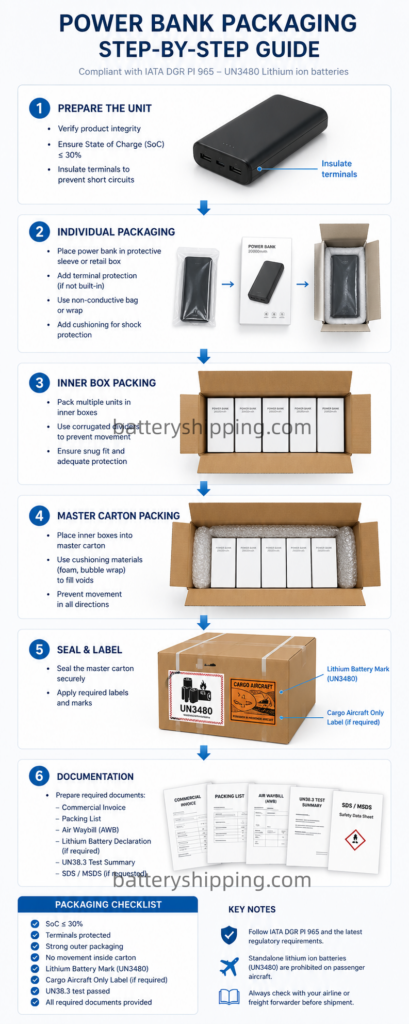
Step 1: Verify Product Data
- Battery chemistry
- Capacity
- Wh rating
- UN38.3 status
Step 2: Control State of Charge
- Ensure ≤30% SoC for UN3480 air shipments
Step 3: Prepare Inner Packaging
- Insulate terminals
- Add cushioning
- Secure each unit
Step 4: Build Master Carton
- Use rigid corrugated packaging
- Add dividers and void fill
Step 5: Apply Labels
- Lithium Battery Mark
- Cargo Aircraft Only label (if required)
Step 6: Prepare Documents
- Invoice
- Packing List
- SDS/MSDS
- UN38.3 Test Summary
Official References
- IATA Dangerous Goods Regulations (DGR), current edition
- Packing Instruction 965 (Lithium ion batteries)
- Section 7: Marking and Labelling
- ICAO Technical Instructions for the Safe Transport of Dangerous Goods by Air
- UN Manual of Tests and Criteria, Part III, Sub-section 38.3
These are the internationally recognized regulatory sources used by airlines, freight forwarders, and customs authorities.
Final Thoughts
Professional power bank packaging is not simply about protecting the product; it is about achieving full compliance with international dangerous goods regulations. A compliant package must:
- Prevent short circuits
- Prevent movement
- Use strong outer packaging
- Meet SoC requirements
- Display correct lithium battery markings
- Be supported by valid UN38.3 documentation
For international air freight, following IATA DGR requirements is essential to ensure safety, regulatory compliance, and successful cargo acceptance.