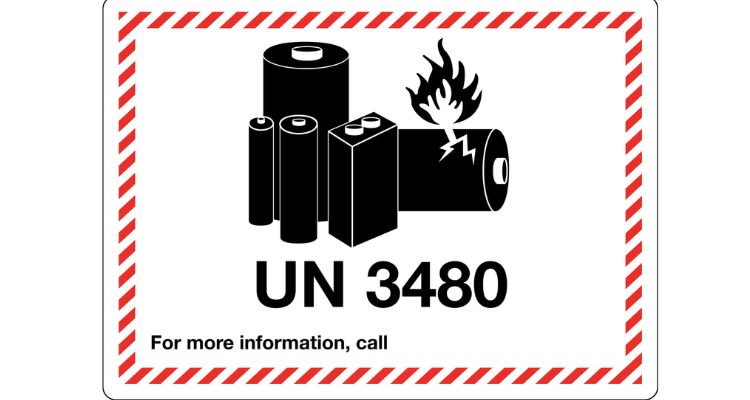
Lithium batteries are classified as dangerous goods (Class 9) under international transport regulations. Their classification, packaging, and acceptance rules are defined by the UN Model Regulations, implemented through IATA Dangerous Goods Regulations (DGR) and IMDG Code.
According to the International Air Transport Association:
“Lithium batteries are dangerous goods and are subject to strict transport requirements depending on their configuration and Watt-hour rating.”
Source: International Air Transport Association (IATA)
Lithium Battery Guidance: https://www.iata.org/en/programs/cargo/dgr/lithium-batteries/
1. What is UN3480?
UN3480 refers to:
Lithium Ion Batteries shipped by themselves (not contained in equipment)
This classification is defined under the UN Recommendations on the Transport of Dangerous Goods.
Source: United Nations
UN Model Regulations: https://unece.org/transport/dangerous-goods/un-model-regulations
Typical examples:
- Loose lithium-ion battery packs
- Power banks (standalone units)
- Battery modules not installed in devices
Regulatory classification:
- UN Number: UN3480
- Hazard Class: Class 9 (Miscellaneous Dangerous Goods)
2. What is UN3481?
UN3481 refers to:
Lithium Ion Batteries contained in equipment OR packed with equipment
This classification is defined under the same UN Dangerous Goods framework and implemented through IATA Packing Instructions.
Two subcategories:
- Batteries contained in equipment
- Batteries packed with equipment
Source: International Civil Aviation Organization (ICAO)
Technical framework: https://www.icao.int/safety/DangerousGoods/Pages/default.aspx
Examples:
- Laptops with built-in batteries
- Mobile phones
- Drones
- Tools shipped with spare batteries
3. IATA Packing Instructions (Critical Section)
According to IATA DGR (Lithium Battery Section):
- PI965 → UN3480 (lithium ion batteries alone)
- PI966 → UN3481 (packed with equipment)
- PI967 → UN3481 (contained in equipment)
Source: International Air Transport Association (IATA)
https://www.iata.org/en/publications/dgr/
4. UN3480 vs UN3481 – Regulatory Comparison
| Feature | UN3480 | UN3481 |
|---|---|---|
| Configuration | Battery alone | Battery with equipment |
| Risk classification | Higher risk | Lower risk |
| Air transport control | Strict | More flexible |
| Packing instruction | PI965 | PI966 / PI967 |
| Feature | UN3480 | UN3481 |
|---|---|---|
| Configuration | Battery alone | Battery with equipment |
| Risk classification | Higher risk | Lower risk |
| Air transport control | Strict | More flexible |
| Packing instruction | PI965 | PI966 / PI967 |
| Airline acceptance | Limited | Wider acceptance |
5. Air Transport Restrictions
According to IATA Dangerous Goods Regulations:
- UN3480 shipments are often restricted to Cargo Aircraft Only
- State of Charge (SoC) limits apply (commonly ≤30%)
- Operator approval is required for most airlines
Source: International Air Transport Association (IATA)
Lithium Battery DGR: https://www.iata.org/en/programs/cargo/dgr/
6. UN38.3 Testing Requirement
All lithium batteries must pass UN38.3 testing before transport.
This requirement is mandated by the UN Manual of Tests and Criteria.
Source: United Nations Economic Commission for Europe
UN38.3 framework: https://unece.org/transport/dangerous-goods/un-manual-tests-and-criteria
7. Packaging Requirements (Regulatory Summary)
Both UN3480 and UN3481 require:
- Protection against short circuits
- Strong outer packaging
- Prevention of accidental activation
- Shock and vibration resistance
These requirements are defined in:
- IATA DGR Packing Instructions (PI965–967)
- IMDG Code (for sea freight)
Source: International Maritime Organization
IMDG Code: https://www.imo.org/en/OurWork/Safety/Pages/DangerousGoods.aspx
8. Key Operational Difference
UN3480 (higher control):
- Requires stricter airline approval
- More frequently rejected if documentation incomplete
- Higher inspection rate
UN3481 (lower control):
- Higher acceptance rate in global air cargo
- More flexible routing options
The distinction between UN3480 and UN3481 is defined by international regulatory frameworks under:
- UN Dangerous Goods Model Regulations
- IATA Dangerous Goods Regulations (DGR)
- ICAO Technical Instructions
Correct classification directly determines:
- Whether cargo is accepted or rejected
- Applicable packing instruction (PI965–967)
- Airline approval requirements
- Safety compliance level
For international logistics operators, strict adherence to these regulations is essential for safe and compliant lithium battery transport.
Contact Details
Speak with our logistics team about battery cargo requirements, shipping routes, transit options, and quotation support. We are available for business inquiries by phone, email, and WhatsApp.
Add Our Wechat