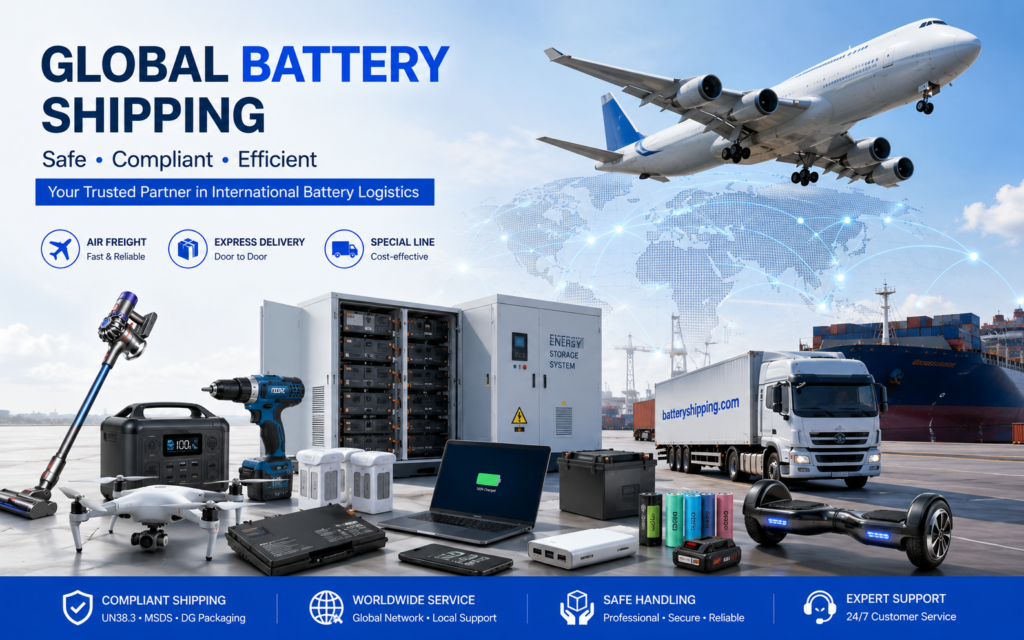
International Lithium Battery Shipping Guide (2026 Edition)
With the rapid growth of global cross-border e-commerce, renewable energy industries, and smart electronic devices, lithium batteries have become one of the most highly regulated and sensitive categories in international transportation. Whether shipping power tool replacement batteries, mobile phone batteries, robotic vacuum batteries, self-balancing scooter batteries, power banks, or residential energy storage cabinets, all shipments must comply with the regulations established by the International Air Transport Association (IATA), the International Civil Aviation Organization (ICAO), and major carriers such as UPS and DHL Express.
The primary risks associated with lithium battery transportation include:
- Thermal runaway
- Short circuits and fire hazards
- Mechanical damage leading to combustion
- Pressure-related ignition risks during air transport
As a result, lithium batteries are classified globally as Class 9 Dangerous Goods.
This guide provides a comprehensive overview of:
- International lithium battery classification systems
- UN numbers and IATA Packing Instructions
- Packaging requirements for lithium batteries
- Documentation requirements and declaration procedures
- Shipping requirements for different battery-powered products
- DHL and UPS lithium battery transportation policies
- Special requirements for energy storage systems and high-capacity batteries
- Common reasons for shipment rejection
- How to establish a compliant lithium battery shipping system
Chapter 1: Basic Classification of Lithium Batteries
In international transportation, lithium batteries are first categorized by chemical composition.
1. Lithium-Ion Batteries
Rechargeable batteries.
Typical applications include:
- Mobile phone batteries
- Laptop batteries
- Power tool replacement batteries
- Robotic vacuum batteries
- Self-balancing scooter batteries
- Power banks
- Residential energy storage cabinets
Key transportation parameters:
- Watt-hour rating (Wh)
- Voltage
- Capacity
2. Lithium Metal Batteries
Non-rechargeable batteries.
Commonly used in:
- Button cells
- Medical devices
- GPS equipment
- Industrial sensors
Key transportation parameter:
- Lithium content
Chapter 2: UN Number Classification System
Lithium batteries transported internationally must be assigned a United Nations (UN) number.
Lithium-Ion Battery UN Numbers
| Battery Type | UN Number |
|---|---|
| Lithium-ion batteries shipped alone | UN3480 |
| Lithium-ion batteries packed with equipment | UN3481 |
| Lithium-ion batteries contained in equipment | UN3481 |
Lithium Metal Battery UN Numbers
| Battery Type | UN Number |
|---|---|
| Lithium metal batteries shipped alone | UN3090 |
| Lithium metal batteries packed with equipment | UN3091 |
| Lithium metal batteries contained in equipment | UN3091 |
Corresponding IATA Packing Instructions:
| Packing Instruction | Applicable UN Number |
|---|---|
| PI965 | UN3480 |
| PI966 | UN3481 packed with equipment |
| PI967 | UN3481 contained in equipment |
| PI968 | UN3090 |
| PI969 | UN3091 packed with equipment |
| PI970 | UN3091 contained in equipment |
Chapter 3: Understanding Section IA, IB, and II
This is one of the most critical structures in lithium battery transportation regulations.
Section IA
Fully regulated dangerous goods.
Characteristics:
- Dangerous Goods Declaration required
- UN-certified packaging required
- Class 9 hazard labels required
- Must be handled by certified dangerous goods personnel
Applicable to:
- Large-capacity batteries
- Industrial batteries
- Energy storage batteries
- Self-balancing scooter batteries
- Residential energy storage cabinets
Example:
A residential energy storage cabinet rated at 51.2V 100Ah:
51.2times100=5120 Wh
This exceeds the 100Wh threshold significantly and is therefore classified as fully regulated dangerous goods.
Section IB
Intermediate classification between fully regulated dangerous goods and simplified shipments.
Characteristics:
- Dangerous goods documentation required
- Lithium battery handling labels required
- Quantity limitations apply
- Enhanced packaging requirements
Common applications:
- Bulk shipments of power tool replacement batteries
- Bulk mobile phone batteries
- E-commerce spare battery inventory
Section II
The most common category for consumer electronics.
Characteristics:
- Simplified documentation
- Full Dangerous Goods Declaration not required
- Lithium battery mark still required
- Packaging requirements remain strict
Applicable to:
- Small consumer electronics
- Mobile phones
- Robotic vacuum cleaners
- Limited quantities of power banks
However:
UN3480 Section II lithium-ion batteries are prohibited on passenger aircraft.
Chapter 4: Watt-Hour (Wh) Limitations
The watt-hour rating is one of the most critical factors in lithium-ion battery transportation.
Calculation formula:
Wh=Vtimes Ah
Example:
A mobile phone battery rated at 3.85V and 5Ah:
3.85times5=19.25 Wh
This qualifies as a small lithium battery.
Core Air Transport Thresholds
| Category | Limitation |
|---|---|
| Cell ≤20Wh | Small lithium cell |
| Battery ≤100Wh | Small lithium battery |
| 100Wh–160Wh | Medium-sized dangerous goods battery |
| >160Wh | Highly restricted dangerous goods |
Chapter 5: Fundamental Packaging Requirements
IATA, DHL, and UPS maintain highly consistent packaging standards for lithium battery transportation.
1. Short Circuit Prevention
Requirements include:
- Terminal insulation
- Individual inner packaging
- Protection against contact with conductive materials
- Prevention of metal-to-metal friction
Common methods:
- Terminal taping
- Blister trays
- Individual PE bags
2. Movement Prevention
Batteries inside the package must not:
- Shift during transport
- Collide with each other
- Be subjected to excessive pressure
Common cushioning materials:
- EPE foam
- EVA foam
- Honeycomb paper
- Protective foam inserts
3. Damage Prevention
Outer cartons must:
- Use strong corrugated cartons
- Provide adequate compression resistance
- Pass drop testing requirements
Section IA shipments generally require:
UN Specification Packaging (UN-certified packaging).
Chapter 6: Labeling Requirements
1. Lithium Battery Mark
Commonly used for UN3481 shipments.
Must include:
- UN number
- Emergency contact telephone number
Applicable to:
- Section II
- Certain Section IB shipments
2. Class 9 Dangerous Goods Label
Required for:
- Section IA
- Section IB
3. Cargo Aircraft Only Label
Standalone lithium-ion batteries (UN3480) and lithium metal batteries (UN3090) are prohibited on passenger aircraft.
Therefore:
Cargo Aircraft Only labels are mandatory.
Chapter 7: Documentation Requirements
1. MSDS (Material Safety Data Sheet)
The most fundamental document.
Includes:
- Chemical composition
- Hazard information
- Firefighting measures
- Storage requirements
Required by almost all logistics channels.
2. UN38.3 Test Report
The most critical compliance document for international lithium battery transportation.
Without a UN38.3 report, regular air transportation is generally impossible.
Testing includes:
- Altitude simulation
- Thermal testing
- Vibration testing
- Shock testing
- External short circuit testing
- Overcharge testing
- Forced discharge testing
3. Transportation Test Reports
Common examples:
- Air Transport Report
- Sea Transport Report
These reports verify compliance with transportation regulations.
4. Shipper’s Declaration for Dangerous Goods
Mandatory for Section IA and IB shipments.
Requires:
- Dangerous goods certification training
- Authorized signature
- Accurate UN classification details
5. Cargo Transport Condition Identification Report
Commonly required for exports from China.
Used for:
- Customs clearance
- Airline approval
Chapter 8: Shipping Case Studies for Different Products
Case Study 1: Mobile Phone Batteries
Product:
Standalone mobile phone battery.
Typical rating:
15Wh.
Classification:
UN3480.
Applicable regulation:
PI965 Section II.
Requirements:
- Individual insulation
- Inner packaging
- Lithium battery mark
- MSDS
- UN38.3 report
Risk factor:
Standalone mobile phone batteries are considered highly sensitive air cargo.
Many logistics channels restrict or reject them.
Case Study 2: Mobile Phones with Installed Batteries
Product:
Smartphone with battery installed.
Classification:
UN3481.
Applicable regulation:
PI967.
Transportation requirements are significantly lower because the battery is installed inside the device.
Case Study 3: Power Tool Replacement Batteries
One of the most common categories in cross-border e-commerce.
Example:
20V 5Ah battery.
20times5=100 Wh
This reaches the critical 100Wh threshold.
If the battery exceeds 100Wh, stricter dangerous goods regulations apply.
Packaging requirements:
- Individual packaging
- Terminal insulation
- Strong cushioning protection
- UN-certified packaging in certain cases
Required documents:
- MSDS
- UN38.3
- Dangerous Goods Declaration (for IB/IA)
Case Study 4: Robotic Vacuum Batteries
Characteristics:
- Typically installed inside equipment
- Lower transportation risk
If installed in equipment:
UN3481 PI967 applies.
This is one of the easiest lithium battery categories to transport internationally.
However:
Including spare batteries may reclassify the shipment under PI966, resulting in stricter requirements.
Case Study 5: Power Banks
Power banks are among the most sensitive lithium battery products in international transportation.
Reason:
A power bank is fundamentally considered a standalone lithium-ion battery.
Typically classified as:
UN3480.
Even though it appears to be a consumer electronic device.
DHL explicitly treats power banks as dangerous goods.
Many countries:
- Strictly regulate them
- Prohibit them in postal channels
- Restrict them on passenger aircraft
Unbranded power banks are especially high-risk.
Case Study 6: Self-Balancing Scooter Batteries
These are considered high-risk dangerous goods.
Reasons include:
- Large battery capacity
- High power output
- History of fire incidents
Most exceed 160Wh.
As a result:
- Standard courier transportation is often impossible
- Dedicated dangerous goods cargo services are required
- Full dangerous goods procedures apply
Many airlines impose direct restrictions.
Case Study 7: Residential Energy Storage Cabinets
This is currently one of the most complex sectors in lithium battery logistics.
Example:
5kWh residential energy storage cabinet.
Essentially:
A large-scale industrial dangerous goods shipment.
Characteristics:
- Extremely high watt-hour rating
- Heavy weight
- Significant thermal runaway risk
Transportation methods typically include:
- Ocean freight
- Dangerous goods cargo transport
- Specialized palletized packaging
Required documents:
- UN38.3
- MSDS
- Dangerous Goods Declaration
- Battery test reports
- Dangerous goods packaging certification
- Transportation identification reports
Packaging requirements:
- UN-certified wooden crates
- Metal securing systems
- Anti-tip protection
- State of Charge (SOC) limitations
Chapter 9: State of Charge (SOC) Restrictions
IATA regulations require:
UN3480 lithium-ion batteries must be shipped at no more than 30% State of Charge.
Purpose:
To reduce thermal runaway risks.
Therefore:
Most air shipments require battery discharge procedures before transportation.
This is especially critical for energy storage systems.
Chapter 10: DHL Lithium Battery Requirements
DHL Express Lithium Battery Guidance
Key DHL characteristics:
- Account approval required
- Dangerous goods review required
- Certain countries restricted
- Extremely strict policies for power banks
DHL explicitly prohibits damaged, defective, or recalled lithium batteries from air transport.
Chapter 11: UPS Lithium Battery Requirements
UPS Battery Shipping Guide
UPS generally provides stronger dangerous goods handling capabilities.
Characteristics:
- Better suited for industrial customers
- More capable for large-volume battery shipments
- Supports broader dangerous goods logistics operations
However, shippers typically require:
- Dangerous goods contracts
- Certified training
- Professional declaration systems
Chapter 12: Common Reasons for Shipment Rejection
1. Missing UN38.3 Report
The most common reason.
2. Non-Compliant Packaging
Examples:
- Battery movement inside packaging
- Missing terminal insulation
- Weak outer cartons
3. Incorrect Labeling
Example:
Declaring UN3480 as UN3481.
4. Capacity Exceeding Regulatory Limits
Example:
Power banks exceeding 100Wh.
5. Misdeclaration
One of the most dangerous practices in the logistics industry.
Potential consequences include:
- Cargo destruction
- Financial penalties
- Blacklisting
- Airline sanctions
Chapter 13: Air Freight vs. Ocean Freight
1,Air Freight
Characteristics:
- Fast
- Expensive
- Highly regulated
Suitable for:
- Consumer electronics
- Mobile phones
- Robotic vacuum cleaners
For route planning and quote support, visit our air freight page or contact page.
2,Ocean Freight
Characteristics:
- Slower
- Higher capacity
- Better suited for large battery systems
Suitable for:
- Self-balancing scooter batteries
- Energy storage cabinets
- Large power batteries
For larger or less time-sensitive cargo, compare our ocean freight service and broader battery shipping solutions.
Chapter 14: Lithium Batteries in Cross-Border E-Commerce
Common products include:
- Smartphones
- Bluetooth earphones
- Power tool replacement batteries
- Power banks
- Robotic vacuum cleaners
Major issue:
Platforms and logistics providers are becoming increasingly strict.
Examples:
- Amazon dangerous goods reviews
- TEMU battery restrictions
- TikTok Shop air transport limitations
Future trend:
“Semi-dangerous goods management.”
More consumer electronics products are gradually entering dangerous goods regulatory systems.
Chapter 15: Future Trends in Lithium Battery Transportation
Global regulations continue to tighten.
Key directions include:
1. Stricter SOC Requirements
2. Enhanced Battery Cell Traceability
3. More Rigorous UN38.3 Verification
4. Independent Regulations for Energy Storage Products
Especially for:
Residential energy storage cabinets.
Dedicated renewable energy logistics systems are likely to emerge globally.
Chapter 16: Building a Compliant Lithium Battery Shipping System
A mature lithium battery logistics company is not simply “shipping batteries.”
It is managing:
A complete dangerous goods compliance system.
Essential Capabilities
1. Product Classification Expertise
Ability to accurately identify:
- UN3480
- UN3481
- PI965
- PI967
2. Documentation Management
Maintaining complete records for:
- MSDS
- UN38.3
- Dangerous goods documentation
3. Standardized Packaging Systems
Establishing:
- SOPs
- Packaging diagrams
- Drop-test standards
4. Transportation Channel Expertise
Different products require different logistics solutions.
Examples:
| Product | Recommended Shipping Method |
|---|---|
| Mobile phones | Standard battery-included channels |
| Power banks | Dangerous goods air freight |
| Self-balancing scooter batteries | Dangerous goods ocean freight |
| Energy storage cabinets | Specialized battery logistics providers |
Chapter 17: Conclusion
International lithium battery transportation is no longer a traditional logistics issue.
It has evolved into:
A highly specialized dangerous goods compliance system.
Over the coming years, industries such as:
- Renewable energy
- Energy storage
- Robotics
- Power tools
- Mobile electronics
will continue expanding rapidly.
Lithium battery logistics will become one of the most important and technically demanding sectors within the global supply chain.
Companies that truly understand:
- IATA regulations
- UN classifications
- Packing Instruction systems
- Dangerous goods documentation
- Packaging compliance
- Aviation safety standards

<<<<<<<<< – ADD Our WeChat
Email us: Peter: petergc@yeah.net
Mobile / Wechat / WhatsApp: +86 13632768961
TEL:+86-755-89239661
Company : QLT Logistics
Visit Us: Address: Fenglin international building B2010- B2011,Auspicious road, Longgang District, Shenzhen,
Hours: Hours: Monday to Saturday, 9:00 AM to 6:00 PM (China Standard Time)